
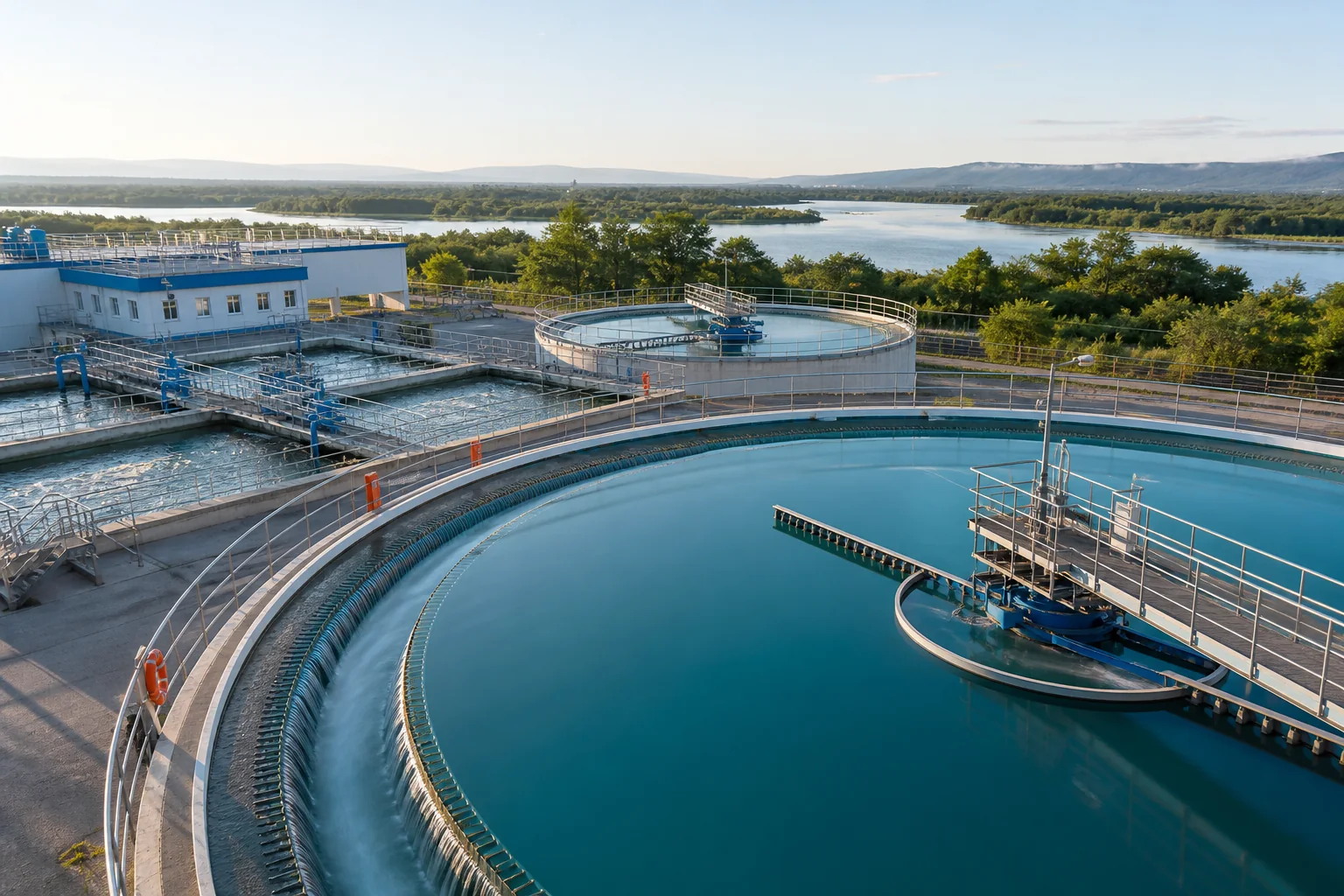
Define the purchasing requirement
River-water polymer selection should cover the states the plant actually needs to treat. A clear-weather sample cannot establish storm performance, and high turbidity alone does not identify an ionic grade. Describe source variability before asking a supplier for a recurring clarification product.
State the treated-water destination and the actual measurement used for acceptance. Keep untested water conditions outside the initial approval rather than extending a sample result to every future operating state.
Separate representative water states
Record normal water and difficult storm or runoff events with time, temperature, pH, alkalinity, turbidity and relevant organic indicators. Note sample storage because settling and biological changes can alter the comparison.
Use the raw-water application record to connect the source to the complete treatment train.
Screen after the actual primary chemistry
Reproduce the coagulant type, dose range, pH correction and mixing sequence. Compare justified PAM profiles with calibrated active additions. Keep coagulation changes separate from polymer changes where possible.
A candidate selected at one favorable coagulant condition has not necessarily passed a different storm-response program.
Approve the outlet and filters together
Measure settled-water clarity and particles where available, then observe relevant filter headloss, ripening and backwash behavior. Retain sludge withdrawal constraints in the plant decision.
Specify the demonstrated source range and review triggers. Do not require one catalogue grade to carry an unlimited seasonal guarantee.
Resolve the limiting condition
After heavy rainfall, a faster-settling jar can still leave more fine carryover than the reference. Check supernatant and filters before treating rapid floc growth as a complete storm-treatment solution.
Keep the incumbent or untreated reference in the comparison and record measurement timing. A repeat trial is preferable to a confident product ranking when observed differences are within sampling or instrument variability.
Record the release conditions
| Purchase check | Required evidence | Approval boundary |
|---|---|---|
| Source | Normal and difficult samples | Tested range visible |
| Chemistry | Actual coagulant program | Sequence representative |
| Output | Settled and filtered water | Downstream duty protected |
Connect the accepted sample, commercial product code, preparation method and operating window. Preserve both failed and acceptable conditions so purchasing can distinguish a bounded recommendation from an unrestricted performance claim.
Request a focused proposal
Send seasonal and event records, chemical sequence, clarifier and filter information, accepted water targets and demand. Request a trial bracket with explicit conditions that require a new screen.
Send the water-treatment PAM sample and quotation request and review quality and delivery requirements with Gongyi Xinqi Polymer Co., Ltd.. Confirm the offered grade and documentation before placing an order.