
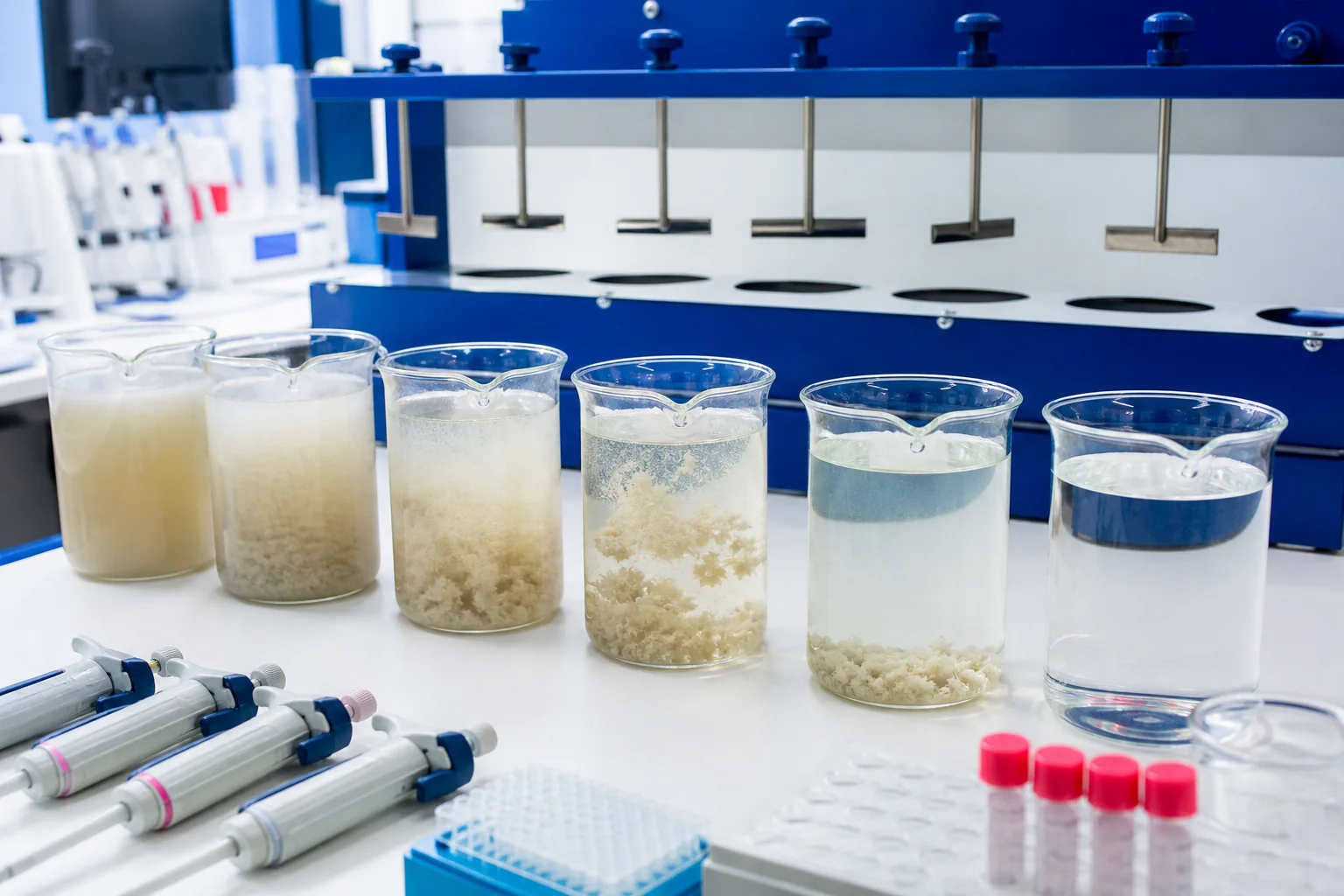
Collect representative water
Sample during a stable operating period and record source, time, temperature, turbidity, pH, alkalinity, conductivity and current chemicals. Test difficult seasonal or production conditions separately.
Mix stored bulk samples gently before splitting jars so settled solids do not create false dose differences.
Prepare a consistent polymer solution
Use suitable preparation water and the same concentration, dispersion, aging and solution age for every candidate. Label product code, lot and preparation time.
Reject visible fish-eyes or failed solutions instead of hiding preparation error inside the grade comparison.
Set the primary coagulant first
If PAM is a coagulant aid, establish a practical metal-salt or primary-coagulant range before fine polymer screening. Keep rapid-mix energy and chemical timing consistent.
Changing coagulant and polymer simultaneously makes the winning mechanism impossible to identify.
Build an active-dose ladder
Calculate several PAM points from underconditioned through useful response and into controlled overdose. Express dose as active polymer per treated water volume and preserve the calculation.
For drinking-water trials, remain within the exact product's applicable maximum use level and site requirements.
Reproduce mixing stages
Use repeatable rapid distribution followed by gentler floc growth and a defined settling period. Match the plant sequence as closely as a bench unit permits.
Do not change paddle speed or timing to help one jar after seeing its initial response.
Measure the supernatant
Record turbidity or particle count at a fixed depth and time, not only visual clarity. Note floating floc, pin floc, wall effects and delayed carryover.
A photograph supports the record but cannot replace timed measurements.
Challenge floc strength
Apply a controlled secondary shear to leading conditions and observe breakage, fines release and reflocculation. This helps represent channels, pumps or filter-inlet energy.
Fragile large floc may lose to a smaller but more resilient condition in the plant.
Repeat the leading point
Repeat the best candidate and a current-treatment reference to reveal variation from sampling, dosing or timing. Report the spread rather than selecting only the favorable jar.
If differences are smaller than method variability, use a pilot or plant comparison before awarding a grade.
Create a plant confirmation plan
Convert the bench result to neat-product and dilution flows using active content and measured plant flow. Define observation points, residence-time delays and stop criteria.
Confirm settled water, filters, residuals handling and chemical consumption across representative operation before final approval.
Control sample and dosing accuracy
Use clean, calibrated pipettes or dispensers and verify the stock-solution calculation before testing. Small addition errors become large relative errors at low PAM doses, while cross-contaminated glassware can make untreated or low-dose jars appear improved.
Record stock concentration, addition volume, vessel volume and active-content assumption with every run.
Report limitations honestly
A jar test cannot reproduce full clarifier inventory, floc blankets, DAF recycle, filter media or every hydraulic short circuit. State which observations are reliable at bench scale and which require pilot or plant confirmation.
Present a candidate range and scale-up controls rather than claiming the jar alone proves a universal operating dose.