
Choose one comparable basis
Water-treatment dose should distinguish neat product, active polymer and prepared solution. Comparing litres per hour or solution percentage alone can hide differences in active content and dilution.
State whether the operating target is milligrams of active polymer per litre of treated water or another documented process basis.
Confirm treated-water flow
Use the flow that actually reaches the dosing point and account for trains in or out of service, recycle streams and meter scaling. Compare the instrument with a suitable independent check.
A flow error moves the true dose even when the polymer pump is perfectly calibrated.
Confirm product active content
Use current product data for the exact grade and lot-control specification. Do not assume powder is 100 percent active or that two liquid formulations have equal solids.
Keep density in the calculation when a liquid product is metered volumetrically.
Calibrate dry feed
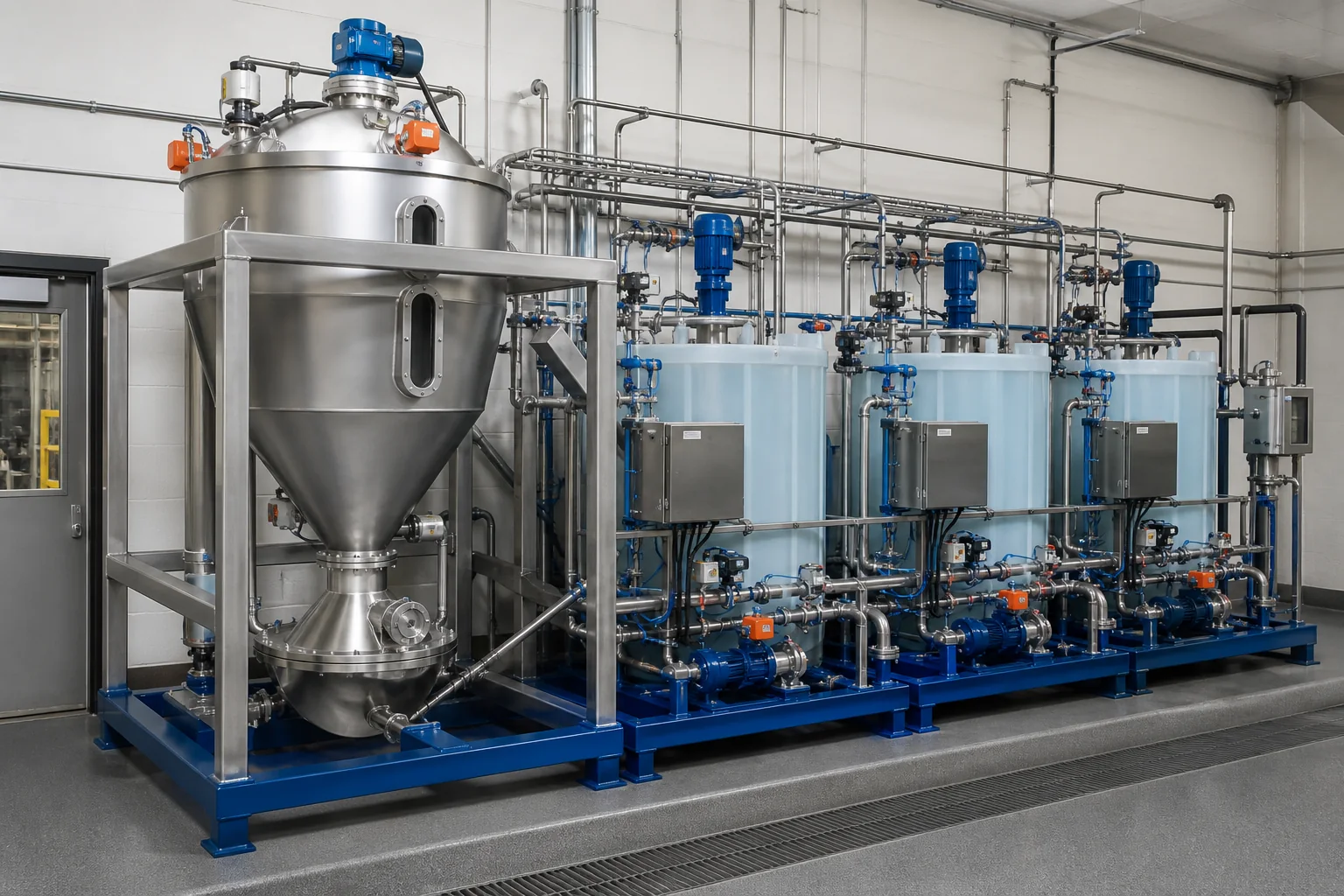
For powder systems, perform a timed mass collection or other safe equipment-specific calibration across representative feeder settings. Check bridging, refill behavior and low-level effects.
The displayed feeder percentage is not itself a mass flow.
Calibrate liquid or solution flow
Use timed drawdown, collection or a verified flow meter appropriate to the system. Record pump speed, stroke, pressure, temperature and calibration date.
Separate neat-product flow from prepared-solution and application-dilution flows.
Apply the mass-balance formula
Active dose in milligrams per litre equals active polymer mass flow in kilograms per hour divided by treated-water flow in cubic metres per hour, with the corresponding unit conversion cancelling to mg/L.
Show each input in the trial record so another operator can reproduce the result.
Reconcile preparation concentration
Prepared-solution concentration provides a cross-check between dry or neat feed and water flow. Unexpected concentration can signal feeder drift, water restriction, tank level error or an incorrect active-content assumption.
Use physical observations and calibration rather than relying on one calculated screen value.
Build a measured dose curve
Calculate every jar or plant step on the same active basis and pair it with settled-water, particle, filter and residuals outcomes. Identify underdose, the stable operating plateau and controlled overdose.
The result is an operating window, not a universal dosage for unrelated water.
Include dose in purchasing
Compare delivered treatment cost using verified active dose, active content, package, freight and preparation losses. A lower product price can be offset by higher required active mass or unstable operation.
Preserve the approved calculation with the commercial product code and change-control requirements.
Use uncertainty ranges
Flow meters, feeder calibration, product active content and laboratory additions each have measurement uncertainty. Calculate how the combined range affects the reported active dose, especially when two candidates appear close.
Do not claim a meaningful chemical saving when the difference is smaller than the reliability of the underlying measurements.
Recalculate after process changes
A new treatment train, altered recycle flow, different preparation concentration or revised certified maximum use level can invalidate an old pump setpoint. Update the mass balance whenever flow routing or product formulation changes.
Keep the revision date, responsible reviewer and source documents with the operating record.