
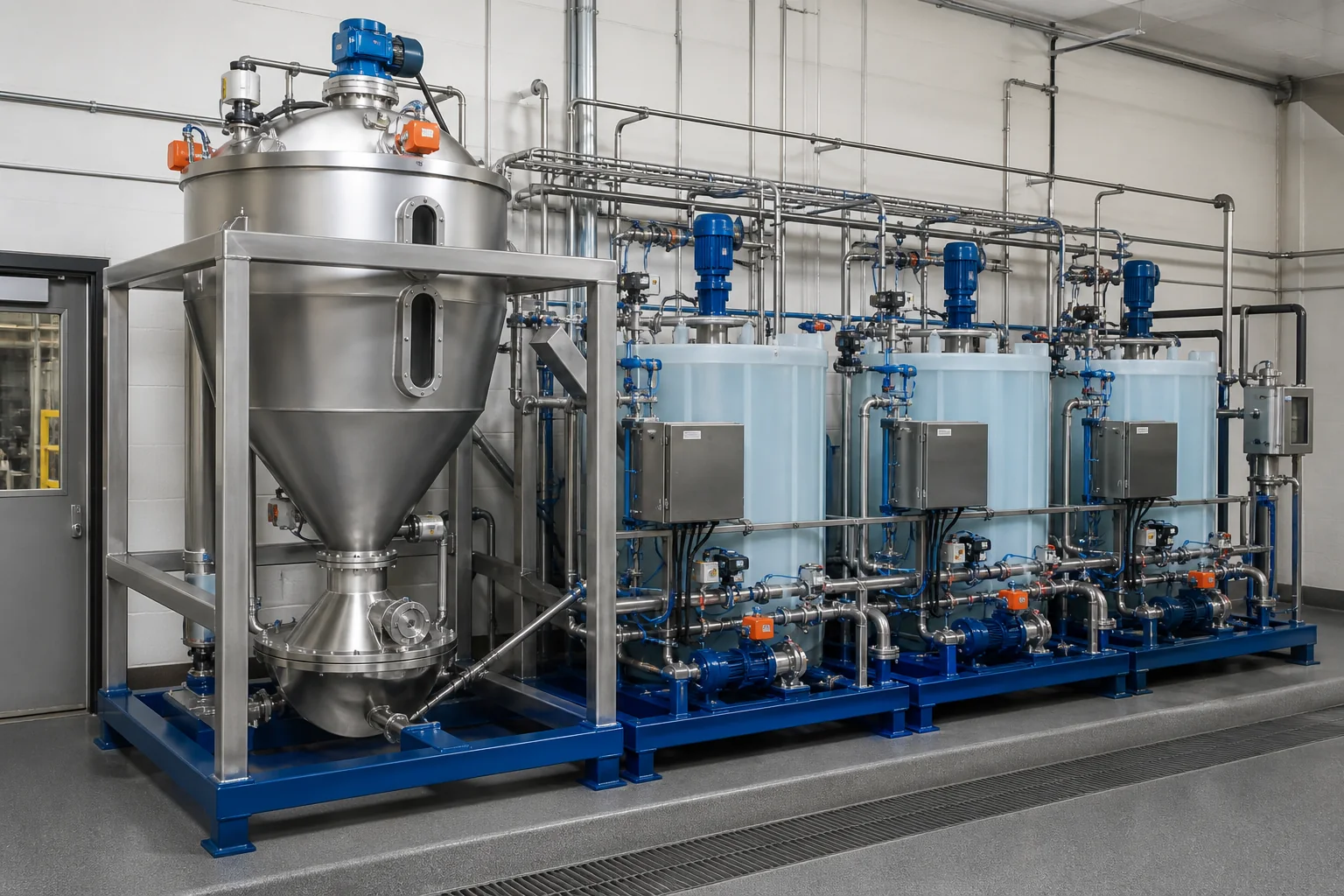
Define the purchasing requirement
Similar product names do not establish an equivalent water-treatment grade. Replacement approval should connect the candidate to the same water, chemical sequence, preparation system and accepted downstream result. Identify whether the reason for substitution is supply continuity, cost or a process limitation.
State the treated-water destination and the actual measurement used for acceptance. Keep untested water conditions outside the initial approval rather than extending a sample result to every future operating state.
Preserve the incumbent baseline
Record the current commercial code, product data, calibrated dose, preparation conditions and operating range. Keep retained material where the site quality system permits. Note unresolved incumbent faults so they are not silently built into the acceptance target.
The make-down record helps separate a grade issue from inconsistent solution production.
Compare before changing the whole train
Use matched water and coagulant conditions with a repeat incumbent reference. Compare dose curves, settled water, filter response and relevant residuals behavior. Document different preparation requirements as genuine operating differences.
A candidate that needs a different dilution or aging arrangement may still be viable, but the change must be feasible and included in approval.
Control the first commercial changeover
Match the accepted sample to the supplied production code and lot. Identify residual incumbent solution, cleaning requirements, stabilization delay and recovery stock. Establish stop criteria and who can authorize a return to the reference program.
Do not blend grades to create an unqualified transition or assume a vendor equivalence statement replaces plant confirmation.
Resolve the limiting condition
If a replacement clears the jar but increases filter headloss during the plant step, retain the split result. Review dose and floc behavior before approving the grade as fully equivalent.
Keep the incumbent or untreated reference in the comparison and record measurement timing. A repeat trial is preferable to a confident product ranking when observed differences are within sampling or instrument variability.
Record the release conditions
| Purchase check | Required evidence | Approval boundary |
|---|---|---|
| Baseline | Incumbent code and operating range | Comparison reproducible |
| Trial | Water, filters and preparation | Whole duty tested |
| Delivery | Lot and changeover plan | First order controlled |
Connect the accepted sample, commercial product code, preparation method and operating window. Preserve both failed and acceptable conditions so purchasing can distinguish a bounded recommendation from an unrestricted performance claim.
Request a focused proposal
Send the substitution reason, incumbent data, plant constraints and delivery forecast. Request a coded alternative with its preparation differences and qualification limits stated before routine supply.
Send the water-treatment PAM sample and quotation request and review quality and delivery requirements with Gongyi Xinqi Polymer Co., Ltd.. Confirm the offered grade and documentation before placing an order.